
Judicial vs. Nonjudicial Foreclosure in Tennessee
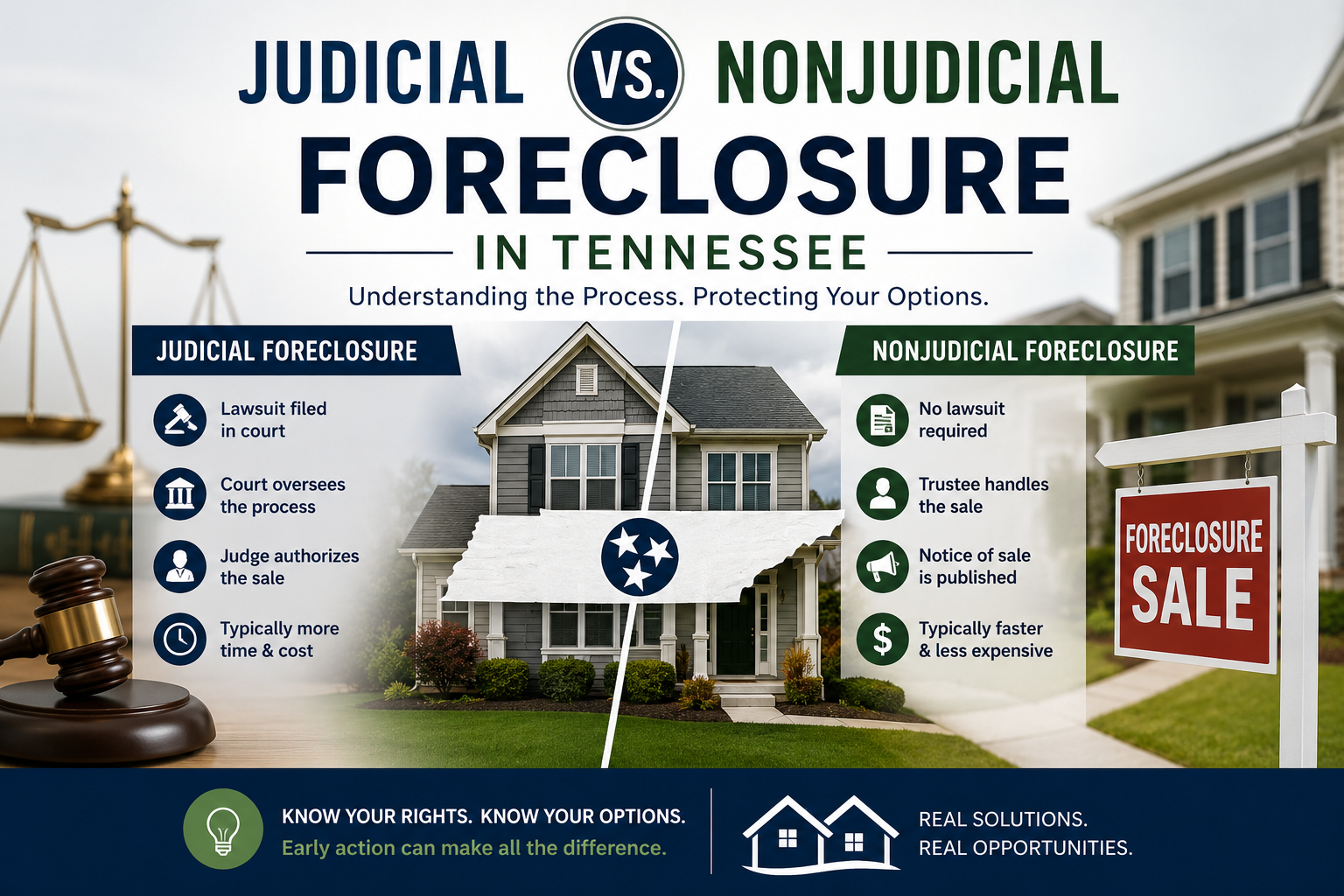
If you own a home in Tennessee and have fallen behind on your mortgage, understanding how foreclosure actually works is critical. Tennessee is primarily a nonjudicial foreclosure state, meaning a lender can often foreclose on a property without first filing a lawsuit and obtaining a court judgment.
That is a major difference from states where foreclosure generally must proceed through the courts.
Tennessee law, however, also permits judicial foreclosure, which involves court proceedings. The two methods can produce the same basic result—the sale of the property to satisfy a debt—but the process, timing, costs, and opportunities to challenge the foreclosure can be very different.
What Is Nonjudicial Foreclosure?
A nonjudicial foreclosure generally occurs when the loan documents—most commonly a deed of trust—give a trustee the authority to sell the property after the borrower defaults.
The lender does not ordinarily have to file a lawsuit simply to conduct the foreclosure sale.
Tennessee courts have repeatedly recognized that nonjudicial foreclosure is the state's predominant foreclosure method. In Smith v. Hughes, the Tennessee Court of Appeals explained that Tennessee's public policy permits foreclosure through nonjudicial sale and that a lender complying with the applicable statutes and deed of trust generally does not have to resort to a judicial forum to foreclose.
How a Typical Nonjudicial Foreclosure Works
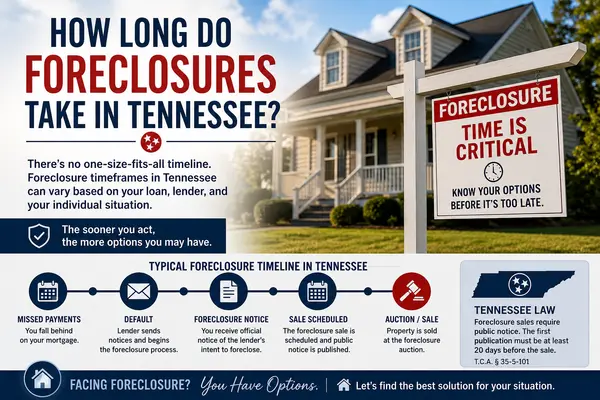
While every foreclosure is different, the process generally involves:
-
The borrower defaults on the loan.
-
The lender or servicer declares a default and begins foreclosure procedures.
-
A trustee or substitute trustee is involved pursuant to the deed of trust.
-
A notice of foreclosure sale is issued.
-
The sale is publicly advertised/noticed as required by Tennessee law and the loan documents.
-
The property is sold at a foreclosure auction.
-
A trustee's deed or similar instrument transfers the property to the successful bidder.
Importantly, there does not necessarily have to be a lawsuit or court hearing before the auction.
Tennessee Foreclosure Notice Requirements
Tennessee's foreclosure-sale notice requirements are found primarily in Tennessee Code Annotated § 35-5-101 et seq.
The notice rules have changed in recent years. In 2025, Tennessee enacted legislation revising the public-notice requirements for foreclosure sales. Current provisions provide for newspaper publication and online posting through a third-party internet posting company, with the initial newspaper publication generally occurring at least 20 days before the sale.
The foreclosure notice requirements matter because a foreclosure is not simply a matter of a lender saying, "You didn't pay, so we're taking the house."
The lender and trustee must follow the applicable statutes, deed of trust, and contractual foreclosure requirements.
Errors involving notice, the identity of the parties, the property, the sale date, or other required procedures can potentially become important in a foreclosure dispute.
What Is Judicial Foreclosure?
A judicial foreclosure is different because the lender uses the court system to enforce the lien against the property.
Instead of simply proceeding with a trustee's sale under a power of sale, the lender files a lawsuit and asks the court to authorize or order the sale of the property.
Judicial foreclosure can become particularly relevant when there are complicated issues involving:
-
Ownership of the property
-
Competing liens
-
Priority disputes
-
Defective or missing foreclosure documents
-
Questions concerning the validity of the lien
-
Disputes involving the borrower or other interested parties
-
Situations in which judicial enforcement is preferable to a trustee sale
Tennessee appellate authority recognizes that foreclosure can occur through either judicial or nonjudicial procedures and that a lender may pursue judicial foreclosure even when a deed of trust contains a power-of-sale provision.
Judicial vs. Nonjudicial Foreclosure: The Key Differences
| Issue | Nonjudicial Foreclosure | Judicial Foreclosure |
|---|---|---|
| Court lawsuit required? | Generally no | Yes |
| Who conducts the sale? | Trustee or authorized party | Court-authorized process |
| Court involvement before sale | Generally none | Yes |
| Typical process | Trustee sale | Lawsuit and court proceedings |
| Can disputes be litigated? | Usually through a separate court action | Directly within the foreclosure lawsuit |
| Complexity | Generally simpler | Generally more complex |
| Cost and time | Often less expensive/faster | Often more expensive/slower |
| Common in Tennessee? | Yes — predominant method | Less common |
Why Tennessee's System Matters to Homeowners
The biggest misconception about foreclosure in Tennessee is that a homeowner will necessarily receive a lawsuit and a court date before the house can be sold.
That is not necessarily true.
Because Tennessee commonly uses nonjudicial foreclosure, a homeowner may receive a foreclosure notice without ever having been served with a traditional lawsuit.
Tennessee courts have described nonjudicial foreclosure as the "almost exclusive" means of foreclosure in the state.
That makes it especially important for homeowners to pay attention to foreclosure notices and deadlines.
Can a Tennessee Foreclosure Be Challenged?
Yes, but homeowners should not assume that every mistake automatically invalidates a foreclosure.
A foreclosure dispute can involve questions such as:
-
Was there actually a default?
-
Was the correct amount owed?
-
Was the borrower given the required notice?
-
Did the trustee have authority to conduct the sale?
-
Was the deed of trust properly executed and recorded?
-
Were required parties properly notified?
-
Were contractual requirements followed?
-
Were there problems with the foreclosure sale itself?
-
Were there circumstances involving fraud, misconduct, or other legal defects?
Tennessee law also recognizes judicial review of foreclosure-related disputes. The fact that a foreclosure is "nonjudicial" does not mean the trustee or lender is completely immune from court scrutiny. Tennessee courts have considered wrongful-foreclosure and related claims arising from nonjudicial sales.
What About the Borrower's Right to Reinstate?
Another important distinction is between stopping a foreclosure before the sale and trying to undo a foreclosure after the sale.
Before the foreclosure sale, a homeowner may have options depending on the loan and circumstances, including:
-
Bringing the loan current
-
Negotiating a repayment arrangement
-
Applying for a loan modification
-
Seeking forbearance
-
Refinancing
-
Selling the property
-
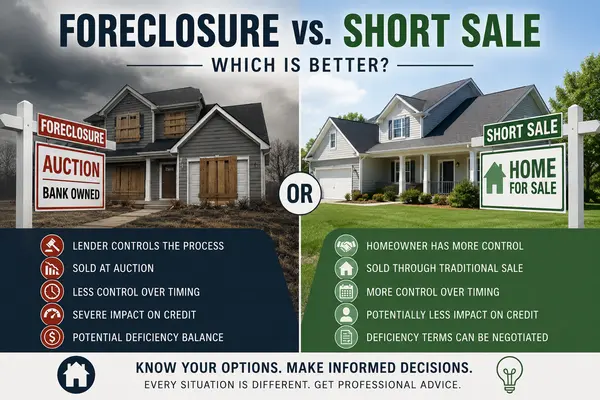
Negotiating a short sale
-
Negotiating another loss-mitigation solution
Once the foreclosure sale occurs, the situation can become substantially more difficult.
That is why homeowners should not wait until the auction date to investigate their options.
What Does This Mean for Real Estate Investors?
For investors and prospective buyers, understanding Tennessee's foreclosure system is equally important.
A property appearing in foreclosure may present an acquisition opportunity, but investors need to understand where the property is in the foreclosure process.
There is a significant difference between:
A homeowner who has received a delinquency notice
and
A homeowner whose foreclosure sale has already been scheduled.
There may also be opportunities to purchase a property before the foreclosure sale, potentially allowing the homeowner to avoid foreclosure while giving the buyer an opportunity to acquire the property.
However, investors should perform proper due diligence, including reviewing:
-
The deed
-
Deed of trust
-
Mortgage balance
-
Foreclosure notice
-
Tax status
-
Existing liens
-
Judgments
-
Bankruptcy filings
-
Title issues
-
Sale date
-
Estimated property value
-
Potential repair costs
A foreclosure does not automatically mean a property is a good deal.
The Bottom Line
Tennessee is primarily a nonjudicial foreclosure state, which means a lender can often foreclose without first obtaining a court judgment. Tennessee law nevertheless permits judicial foreclosure in appropriate circumstances.
The distinction is important because a homeowner facing a nonjudicial foreclosure may not receive the same type of court notice that someone in a judicial-foreclosure state would expect.
If you are facing foreclosure in Tennessee, do not wait for a lawsuit before taking action.
The earlier you understand the amount owed, the foreclosure-sale date, the status of the loan, and your available options, the more possibilities you may have.
And for buyers and investors, foreclosure season can create opportunities—but the best opportunities usually come from understanding the process before the property reaches the courthouse steps or foreclosure auction.
This article is for general educational purposes and is not legal advice. Tennessee foreclosure law can be fact-specific. Anyone facing an active foreclosure should consider consulting a qualified Tennessee attorney about their particular situation.
Tennessee Foreclosure Resources
Tennessee's foreclosure-sale requirements are primarily contained in Tennessee Code Annotated Title 35, Chapter 5, including §§ 35-5-101 through 35-5-118.
Tennessee's courts have also specifically recognized the state's strong reliance on nonjudicial foreclosure.
Categories
Recent Posts




GET MORE INFORMATION