
Facing Foreclosure in Tennessee? Understand Your Options Before You Lose Your Home
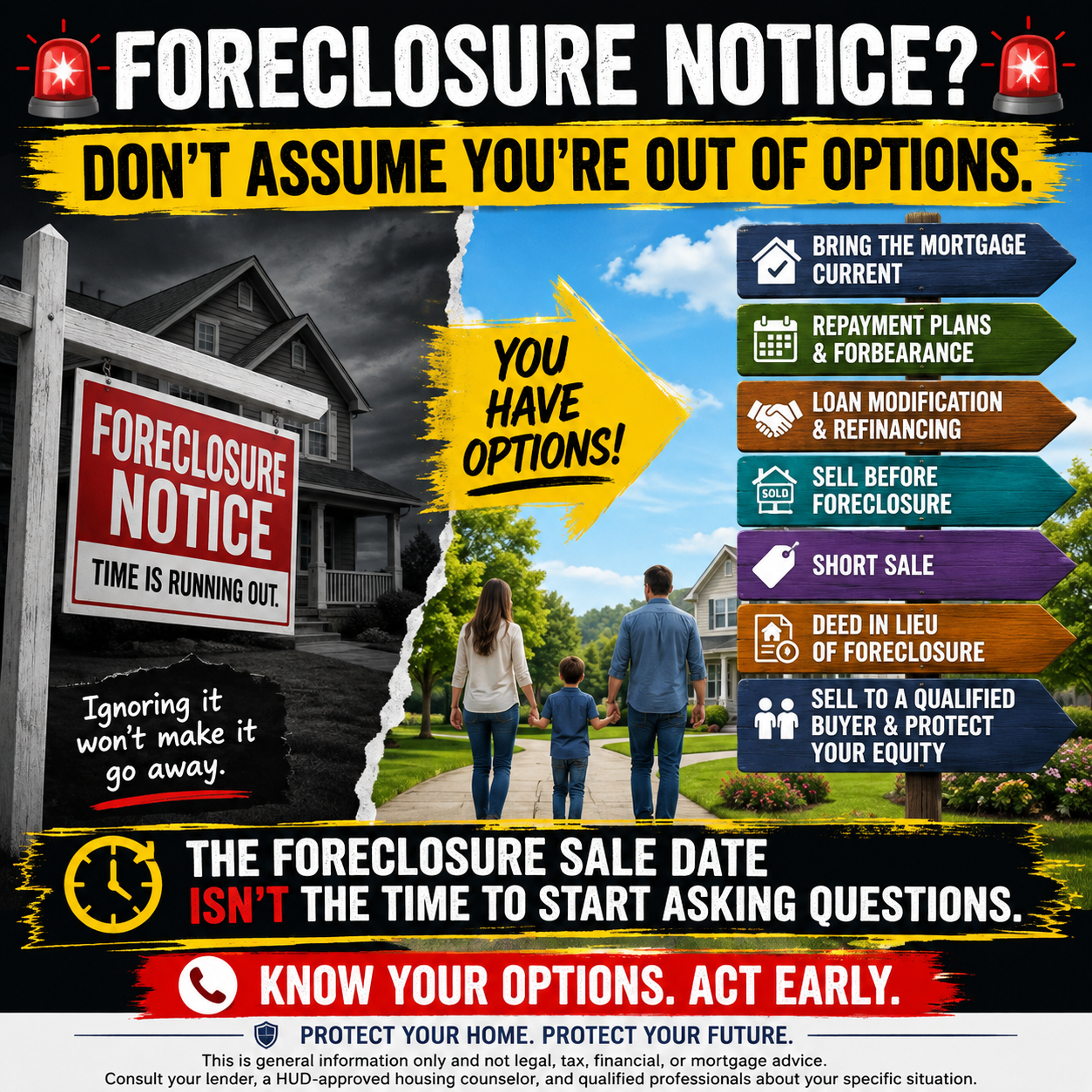
Foreclosure can feel like the end of the road—but it doesn't necessarily have to be.
If you are behind on your mortgage in Tennessee, the most important thing you can do is act early. The longer a homeowner waits, the fewer options may be available.
Depending on your circumstances, you may be able to keep your home through a repayment plan, forbearance, loan modification, refinancing, or other loss-mitigation options. If keeping the home is no longer financially realistic, selling the property before foreclosure may provide another path.
And for homeowners who have equity but cannot afford to bring the mortgage current, selling the home to a qualified buyer before the foreclosure sale may be an option worth investigating.
What Is Foreclosure?
Foreclosure is the process through which a mortgage lender or other secured creditor enforces its rights against property after a borrower defaults on the loan.
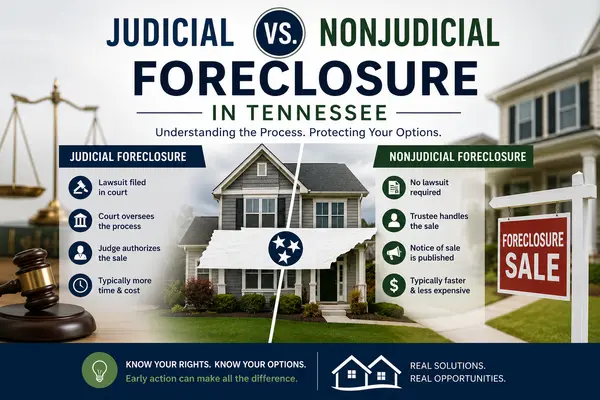
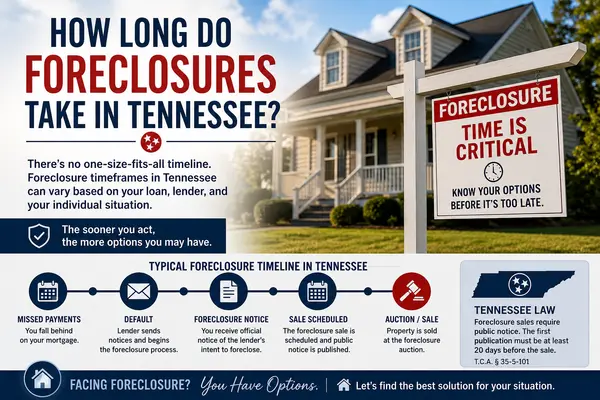
Tennessee allows foreclosure sales under certain circumstances through a deed of trust, mortgage, or other lien. Tennessee law establishes requirements concerning public notice of foreclosure sales, while the loan documents can also contain important requirements.
The exact process and timing can depend on the mortgage documents, type of loan, property, and circumstances surrounding the default.
That is why homeowners should not assume that every Tennessee foreclosure follows exactly the same timeline.
Your First Step: Contact Your Mortgage Servicer
If you have missed payments, don't ignore your lender's calls and letters.
HUD specifically recommends contacting the mortgage lender or servicer as soon as you realize you are having difficulty making payments. Lenders may have loss-mitigation programs designed to help borrowers avoid foreclosure.
The sooner you act, the more opportunities you may have.
When speaking with your mortgage servicer, ask:
- How much is currently past due?
- What is the total amount required to reinstate the loan?
- Has foreclosure been initiated?
- Has a foreclosure sale been scheduled?
- What is the deadline for submitting a loss-mitigation application?
- Am I eligible for a repayment plan?
- Am I eligible for a forbearance?
- Am I eligible for a loan modification?
- Can the loan be reinstated?
- What amount would be required to bring the loan current?
Do not rely solely on an estimated balance. Get the information from the mortgage servicer in writing whenever possible.
Option 1: Bring the Mortgage Current
For some homeowners, the simplest solution is also the most effective:
Pay the delinquent amount and bring the mortgage current.
This may involve paying:
- Missed mortgage payments
- Late charges
- Certain fees and costs
- Other amounts required by the loan documents or servicer
The exact amount needed to reinstate a loan can change, so homeowners should request a current reinstatement or payoff figure directly from the servicer.
If you have access to the money—through savings, family assistance, sale of another asset, or another legitimate source—bringing the mortgage current may allow you to keep the property.
HUD notes that the further behind a homeowner becomes, the harder it can become to reinstate the loan and avoid foreclosure.
Option 2: Repayment Plan
If you cannot pay the entire delinquency immediately, your mortgage servicer may offer a repayment plan.
Under a repayment plan, the missed payments may be spread over a period of time and added to the regular mortgage payments.
For example, instead of paying a large delinquent balance immediately, the homeowner might pay the regular mortgage payment plus an additional amount each month until the delinquency is resolved.
The availability and terms depend on the loan and servicer.
Option 3: Forbearance
A forbearance may temporarily reduce or suspend mortgage payments while the homeowner addresses a financial hardship.
Forbearance does not necessarily erase the missed payments.
The homeowner generally must have a plan for dealing with the amounts that were deferred or reduced.
For FHA borrowers, HUD identifies forbearance and repayment plans among the available home-retention tools, subject to eligibility requirements.
Option 4: Loan Modification
A loan modification changes the terms of an existing mortgage.
Depending on the program and circumstances, a modification may potentially change things such as:
- Interest rate
- Payment amount
- Loan term
- Treatment of past-due amounts
The goal is to create a payment structure that the homeowner can realistically maintain.
There is no guarantee that a modification will be approved, so homeowners should apply as soon as they recognize a financial problem.
HUD emphasizes that lenders have workout options, but those options generally become more limited as a borrower falls further behind.
Option 5: Refinancing
If the homeowner has sufficient equity, income, credit, and qualifies for a new loan, refinancing may be another possibility.
A new mortgage could potentially be used to pay off the existing mortgage and resolve the delinquency.
However, refinancing a property that is already in serious default can be difficult.
The homeowner may also face:
- Higher interest rates
- Closing costs
- Qualification requirements
- Appraisal requirements
- Income requirements
- Time constraints
Refinancing should therefore be investigated before the foreclosure process becomes too advanced.
Option 6: Sell the Home Before Foreclosure
Sometimes the best solution isn't keeping the house.
It may be selling the house before the foreclosure sale occurs.
This can make particular sense when the homeowner has enough equity to:
- Pay off the mortgage;
- Pay the delinquent amounts and other required costs;
- Pay the costs of selling the property; and
- Potentially retain remaining equity.
For example:
Estimated home value: $300,000
Mortgage balance: $210,000
Past-due payments and costs: $15,000
Estimated selling costs: $20,000
The homeowner could potentially sell the property, satisfy the obligations at closing, and retain the remaining equity, subject to the actual payoff and transaction costs.
The numbers must be calculated using actual title, payoff, and closing figures—not estimates.
Option 7: Sell the Home to a Buyer Who Can Help Resolve the Delinquency
This is an option that many homeowners don't realize may exist.
Suppose a homeowner has:
- A mortgage that is seriously delinquent;
- A foreclosure sale approaching;
- Significant equity in the property; but
- Not enough cash to bring the mortgage current.
A potential buyer may purchase the property before the foreclosure sale.
The transaction can be structured so that the mortgage and other liens are addressed through the closing process, with the seller receiving any remaining equity after the required obligations and transaction expenses are satisfied.
Example
Imagine:
Home value: $350,000
Mortgage payoff: $250,000
Past-due amount: $25,000
Other liens/closing costs: $20,000
Rather than allowing the property to proceed to foreclosure, the homeowner could explore selling the property.
If a qualified buyer purchases the home for an amount sufficient to satisfy the required obligations, the transaction could potentially resolve the mortgage delinquency while allowing the homeowner to preserve some of the equity.
The actual numbers would need to be verified by the lender, title company, and closing professionals.
What About a Buyer Paying the Mortgage to Bring It Current?
This is where homeowners need to be particularly careful.
There are circumstances where a buyer and seller may explore a transaction involving an existing mortgage, but simply making the seller's mortgage payments does not automatically transfer ownership of the mortgage or make the buyer the borrower.
Mortgage documents can contain provisions concerning transfers of ownership, and some loans may be assumable only under specific conditions.
A buyer should not assume that they can simply start making the seller's payments and legally take over the property.
There are potentially several different transaction structures, including:
- A conventional purchase where the existing mortgage is paid off;
- A lender-approved assumption when permitted;
- Other legally structured transactions involving existing financing.
The specific loan documents and circumstances matter.
Any transaction involving an existing mortgage should be reviewed by a qualified real-estate attorney and the appropriate title/closing professionals before the parties sign documents or transfer money.
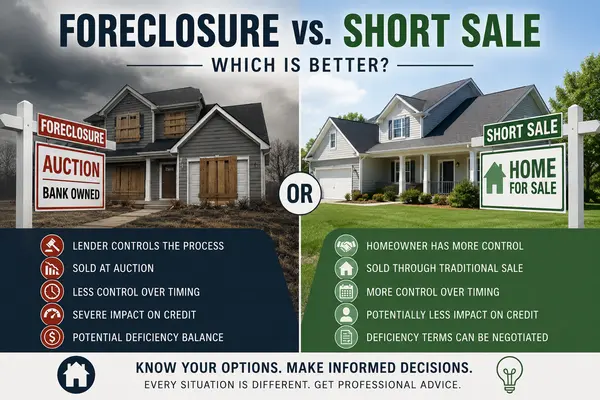
What Is a Short Sale?
A short sale occurs when the property cannot be sold for enough money to fully satisfy the mortgage and the lender agrees to accept less than the full amount owed, subject to the applicable program and approval.
For example:
Mortgage payoff: $300,000
Market value: $260,000
If the homeowner cannot sell for enough to pay the mortgage in full, a short sale may be an alternative to foreclosure.
For certain FHA borrowers, HUD identifies a Pre-Foreclosure Sale, also known as a short sale, as a potential disposition option when the borrower cannot retain the home through available home-retention options.
A short sale generally requires lender/servicer approval.
Option 8: Deed in Lieu of Foreclosure
Another possible alternative is a deed in lieu of foreclosure.
In this arrangement, the homeowner voluntarily transfers the property to the lender in exchange for the lender accepting the property instead of completing foreclosure, subject to the lender's requirements and approval.
This can sometimes be preferable to a completed foreclosure, but it is not automatically available and does not necessarily eliminate every financial obligation.
Homeowners should obtain professional advice before signing a deed or other documents transferring their property.
Option 9: Sell to Preserve Your Equity
One of the biggest mistakes a distressed homeowner can make is assuming:
"I'm going into foreclosure, so I have nothing to lose."
That may be completely wrong.
If your home is worth substantially more than the mortgage and other obligations, you may have equity that can potentially be preserved through a sale before foreclosure.
Consider a homeowner with:
Home value: $400,000
Mortgage balance: $250,000
Even if the homeowner is behind on payments, there could still be substantial equity.
A properly structured sale may allow the homeowner to resolve the mortgage, pay transaction expenses and other required obligations, and retain some of the remaining equity.
That's why getting an accurate estimate of your home's value and your lender's payoff information is important.
What If the Foreclosure Sale Has Already Been Scheduled?
Don't assume that a scheduled foreclosure sale means there is nothing you can do.
The available options can become much more limited as the sale approaches, but the homeowner should immediately:
- Contact the mortgage servicer;
- Request the current reinstatement amount;
- Determine the exact foreclosure-sale date;
- Ask whether a loss-mitigation application can still be submitted;
- Determine whether the property can be sold before the foreclosure;
- Speak with a HUD-approved housing counselor; and
- Consult a Tennessee attorney if there are legal questions concerning the foreclosure.
Tennessee has specific statutory requirements concerning foreclosure-sale notices, and the loan documents can also affect the process.
Time matters.
What If You Have Little or No Equity?
The strategy changes if the home isn't worth enough to pay the mortgage.
In that situation, options may include:
- Loan modification
- Repayment plan
- Forbearance
- Short sale
- Deed in lieu
- Other lender-approved loss mitigation
The right option depends on the loan, homeowner's finances, property value, and stage of the foreclosure.
Don't Ignore Your Mortgage Servicer
Ignoring the problem rarely makes it disappear.
HUD specifically warns homeowners not to ignore foreclosure notices and encourages them to contact their lender as soon as financial difficulty occurs.
You should keep copies of:
- Mortgage statements
- Default notices
- Foreclosure notices
- Emails
- Letters
- Payment records
- Loss-mitigation applications
- Documents submitted to the servicer
- Names and dates of people you speak with
Good documentation can become extremely important.
Beware of Foreclosure Rescue Scams
Distressed homeowners are particularly vulnerable to scams.
Be cautious about anyone who:
- Guarantees they can "stop foreclosure";
- Tells you to stop communicating with your lender;
- Asks you to sign over your deed without explaining the transaction;
- Promises to save your home regardless of your financial circumstances;
- Demands large upfront fees;
- Tells you not to contact an attorney;
- Tells you to make mortgage payments directly to them instead of the lender.
HUD warns homeowners about foreclosure-rescue scams and recommends carefully reviewing documents before signing away rights or ownership of a home.
Free Help May Be Available
Homeowners don't necessarily have to navigate foreclosure alone.
HUD recommends working with a HUD-approved housing counselor, and Tennessee homeowners can use HUD's resources to locate approved counseling agencies.
HUD's Tennessee resources also direct homeowners facing foreclosure toward Tennessee Housing Development Agency resources and other assistance programs.
Find a HUD-approved housing counselor
The Bottom Line
Foreclosure is serious, but it isn't necessarily your only option.
Depending on your situation, you may be able to:
- Bring the mortgage current;
- Negotiate a repayment plan;
- Obtain forbearance;
- Modify the loan;
- Refinance;
- Sell the property;
- Sell before the foreclosure sale;
- Pursue a lender-approved short sale;
- Explore a deed in lieu of foreclosure; or
- Explore a properly structured purchase transaction where the existing mortgage obligations are addressed through the closing process.
The key is knowing your numbers and acting before the foreclosure sale occurs.
If you are behind on your mortgage, start by finding out three things:
1. What is my home worth?
2. What is my current mortgage payoff?
3. What amount is required to bring the loan current?
Once you know those numbers, you can start determining whether keeping the home, refinancing, selling, or another solution makes the most financial sense.
Considering Selling Your Tennessee Home Before Foreclosure?
If you're a Tennessee homeowner who has received foreclosure notices or is struggling to catch up on mortgage payments, you may have options that you haven't considered.
A real-estate professional can help you evaluate the property's market value and determine whether selling before foreclosure may be a viable option.
Don't wait until the foreclosure sale is tomorrow. The sooner you understand your options, the more choices you may have.
This article is for general educational purposes and is not legal, tax, financial, or mortgage advice. Foreclosure laws, lender requirements, loan programs, and individual circumstances vary. Homeowners should consult the mortgage servicer, a HUD-approved housing counselor, and an appropriately licensed attorney or other qualified professional when necessary.
Categories
Recent Posts



GET MORE INFORMATION